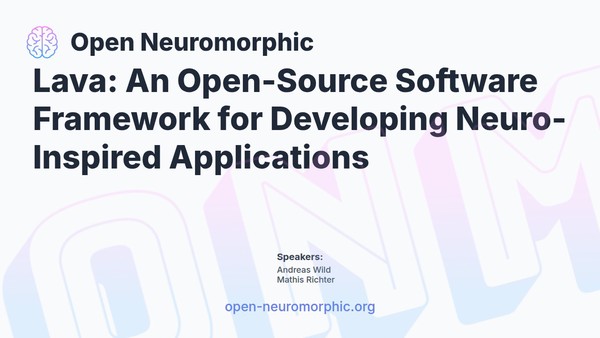
Intel’s Lava framework addresses the historical fragmentation of neuromorphic software by providing an open-source, hardware-agnostic stack. Built on an explicitly parallel and asynchronous programming model, Lava enables developers to construct neuro-inspired applications that compile seamlessly to standard CPUs, GPUs, and specialized neuromorphic backends like Loihi 2.
Key Takeaways
- Lava utilizes an asynchronous, event-based programming model where independent processes communicate strictly via message passing.
- The framework is hardware-agnostic, capable of compiling heterogeneous workloads to CPUs, GPUs, and Loihi neurocores.
- Lava includes specialized algorithm libraries like Lava DL for deep learning and Lava Optim for quadratic and continuous constraint optimization.
- The software stack allows developers to map high-level behaviors to distinct hardware models using a unified API.
Workshop Format & Takeaways
The session provided a comprehensive structural overview of the Lava software stack, moving from runtime concepts to high-level application libraries. Instead of relying on standard neural network “layers,” Lava abstracts everything as a “Process”—a fundamental building block that communicates via asynchronous message channels.
The workshop detailed Lava’s algorithmic libraries, highlighting Lava DL (for training deep neural networks and performing hardware-aware quantization) and Lava Optim (which leverages recurrent dynamics to achieve orders-of-magnitude gains on constraint satisfaction and quadratic programming problems). The speakers also detailed the network exchange format (netx), demonstrating how an SNN trained offline in Lava DL is instantiated and deployed directly to Loihi 2 for real-time inference.
As discussed in the session, Lava maintains a clear separation between its open-source API (available on GitHub for CPU/GPU simulation) and its proprietary Loihi backend extensions, which remain restricted to Intel Neuromorphic Research Community (INRC) members.
What This Means for Neuromorphic Computing
Lava represents a significant step toward tooling convergence in the neuromorphic community. By abstracting hardware-specific requirements behind an open, process-oriented API, developers can focus on algorithmic design without being locked into a single proprietary hardware SDK. This structural flexibility opens the door to cross-platform benchmarks and broader adoption in standard computing workflows.
Resources
Upcoming Workshops
No workshops are currently scheduled. Check back soon for new events!
Are you an expert in a neuromorphic topic? We invite you to share your knowledge with our community.
Inspired? Share your work.
Share your expertise with the community by speaking at a workshop, student talk, or hacking hour. It’s a great way to get feedback and help others learn.