Neuromorphic Workshops
Dive into the world of Neuromorphic Computing and Robotics at Open Neuromorphic's Workshops. Explore visual attention mechanisms, innovative hardware design, and more with expert speakers.

Vector Symbolic Algebras and Neural Computation
Discover how Vector Symbolic Algebras enable Bayesian optimization that matches state-of-the-art robotics results without cubic scaling in sample count.
Upcoming Workshops
No workshops are currently scheduled. Check back soon for new events!
Are you an expert in a neuromorphic topic? We invite you to share your knowledge with our community.
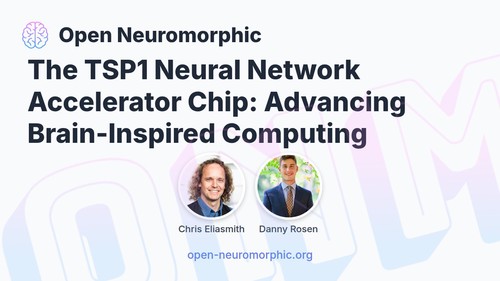
The TSP1 Neural Network Accelerator Chip: Advancing Brain-Inspired Computing
The TSP1 accelerator chip runs Legendre Memory Units (LMUs) to deliver state-of-the-art time-series inference at milliwatt power levels.
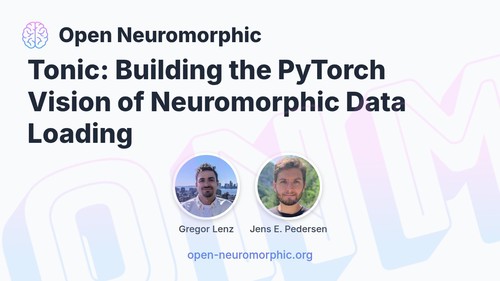
Tonic: Building the PyTorch Vision of Neuromorphic Data Loading
The Tonic library standardizes event-based data loading and transformation, providing a PyTorch-compatible pipeline that accelerates SNN model training.
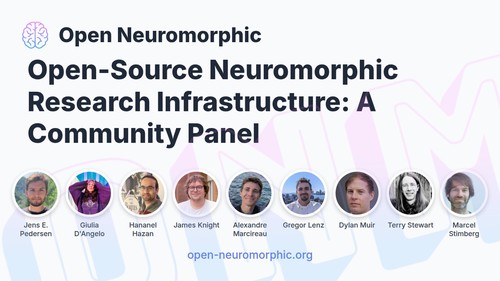
Open-Source Neuromorphic Research Infrastructure: A Community Panel
Nine neuromorphic tool maintainers navigate open-source funding, standardize edge deployments, and successfully balance commercial scale with biological realism.
Project Phasor - Kickoff
Project Phasor is a community initiative building shared compilers, behavioral virtual machines, and open datasets to scale neuromorphic computing workloads.
C-DNN and C-Transformer: mixing ANNs and SNNs for the best of both worlds
The C-Transformer architecture dynamically routes language model workloads between ANN and SNN cores based on spike sparsity, reducing LLM energy by up to 72%.
Advances in Neuromorphic Visual Place Recognition
Sampling a tiny subset of high-variance event pixels allows robotic visual place recognition systems to successfully operate with low latency and minimal storage.
Accelerating Inference and Training at the Edge
Digital in-memory computing and INT8 quantization directly accelerate efficient edge training and inference for small vision models on neuromorphic hardware.
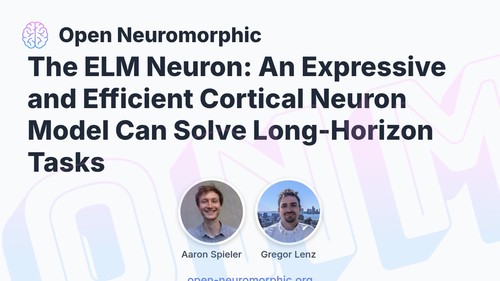
The ELM Neuron: An Expressive and Efficient Cortical Neuron Model Can Solve Long-Horizon Tasks
The Expressive Leaky Memory (ELM) neuron leverages few memory states and nonlinear dendritic processing to solve long-horizon tasks efficiently.
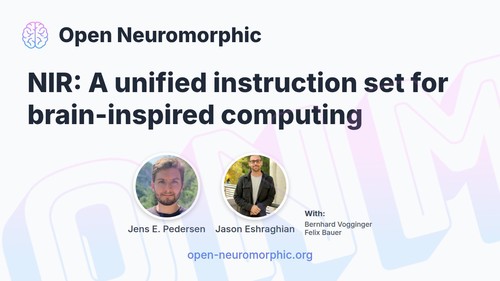
NIR: A unified instruction set for brain-inspired computing
See how the Neuromorphic Intermediate Representation (NIR) enables seamless SNN model deployment across Norse, SynSense Speck, and SpiNNaker2 hardware.
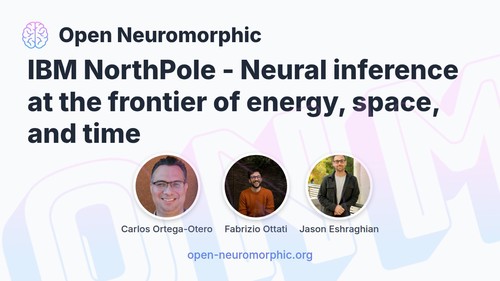
IBM NorthPole - Neural inference at the frontier of energy, space, and time
IBM's NorthPole chip intertwines memory and compute, achieving 25x higher energy and 5x higher space efficiency than conventional architectures.
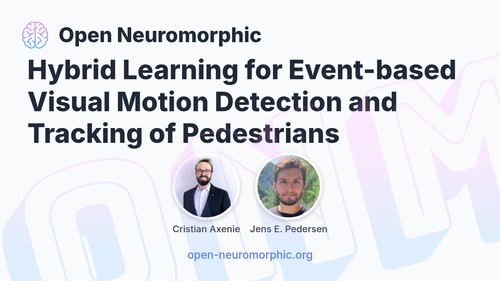
Hybrid Learning for Event-based Visual Motion Detection and Tracking of Pedestrians
A hybrid Spiking Neural Network and event-based Expectation Maximization pipeline deployed on the BrainChip Akida tracks pedestrians with a ~6W power footprint.
Programming Scalable Neuromorphic Algorithms with Fugu
Discover how the Fugu framework provides a hardware-agnostic intermediate representation for programming scalable, non-deep-learning neuromorphic algorithms.
Spyx Hackathon: Speeding up Neuromorphic Computing
Spyx is a JAX-based SNN framework that leverages JIT compilation to fuse training loops and execute entirely on the GPU, reducing training times to minutes.
Making Neuromorphic Computing Mainstream
SoftHebb learning and short-term plasticity mechanisms improve state-of-the-art AI performance on dynamic tasks without relying on non-local backpropagation.
Building Neuromorphic Applications Using Talamo
Innatera's Talamo SDK streamlines deploying spiking neural network architectures to mixed-signal neuromorphic hardware for low-power edge audio processing.
What's Catching Your Eye? The Visual Attention Mechanism
A bio-inspired visual attention model leverages event cameras and SpiNNaker neuromorphic hardware to give robotic agents low-latency, depth-aware object focus.
From C/C++ to Dynamically Scheduled Circuits
Dynamically scheduled dataflow circuits overcome static high-level synthesis limits to enable out-of-order memory and speculative execution from C/C++ code.
Does the Brain do Gradient Descent?
Examining the biological plausibility of gradient descent reveals how node perturbation and feedback alignment successfully bypass the weight transport problem.
Low-power Spiking Neural Network Processing Systems for Extreme-Edge Applications
The Microbrain architecture combines asynchronous processing and Forward Propagation Through Time (FPTT) to train 6.2-million-neuron SNNs.
Lava: An Open-Source Software Framework for Developing Neuro-Inspired Applications
Explore how Intel's Lava framework uses asynchronous message passing and specialized libraries to compile neuromorphic workloads for Loihi 2 and CPUs.
Hands-on with Xylo and Rockpool
The SynSense Xylo hardware and Rockpool toolchain enable the efficient training and direct deployment of spiking neural networks for audio classification.
Hands-On with Sinabs and Speck
See a complete workflow for training spiking neural networks in PyTorch with Sinabs and deploying them directly to the event-driven Speck neuromorphic chip.
Evolutionary Optimization for Neuromorphic Systems
The EONS framework applies evolutionary algorithms to co-design spiking neural network topologies and parameters for diverse neuromorphic hardware.
Towards Training Robust Computer Vision Models for Neuromorphic Hardware
Learn how to overcome the discrepancies between synchronous GPU training and asynchronous deployment when building SNNs for SynSense's Speck chip.
Hands-On with snnTorch
snnTorch applies surrogate gradients to overcome the non-differentiability of spikes, enabling SNN training and quantization using standard PyTorch pipelines.
PEPITA - A Forward-Forward Alternative to Backpropagation
PEPITA is a biologically plausible learning algorithm that replaces backpropagation with a dual forward-pass mechanism utilizing error-modulated network inputs.
Hands-On with Nengo Applied Brain Research
The Neural Engineering Framework and Nengo's core Python objects accurately translate high-level algorithmic intentions into functional spiking neural network models.
Inspired? Host an event.
Share your expertise with the community by hosting a workshop, student talk, or hacking hour. It’s a great way to get feedback and help others learn.